
Frequently asked questions
Everything you need to know about made-to-measure shower screens, room dividers and sliding glass doors.
Shower screens
How much does a made-to-measure shower screen cost?
Price depends on the model (fixed, sliding or hinged), the size, the glass thickness (6, 8 or 10 mm) and the hardware chosen, so we don't work with a fixed price list. The screen's price does not include installation, which is quoted separately. We recommend requesting a personalised quote to get the exact cost for your project.
Does the screen's price include installation?
No, the price of the screen and the price of installation are quoted separately, so you can clearly see the cost of the product and of the fitting in your quote.
Do you charge for coming to take measurements?
No, an in-home measurement visit is always free and comes with no obligation. Our team or an installer from our network visits your home to check the exact opening before manufacturing the screen.
When you install a new screen, do you remove the old one?
Yes, removal of the old screen is normally included in the installation service. The exception is very large sizes or compositions, where an extra cost for removal may apply — we'd flag this in your quote.
Which shower screen is best: fixed, sliding or hinged?
It depends on the space and how you use it. A fixed screen is the most minimalist option and the easiest to clean; a sliding screen makes better use of narrow bathrooms since it needs no swing space; and a hinged door gives a wider sense of opening but needs free space in front of the shower. We can advise based on your bathroom's exact measurements.
What screen suits a small bathroom or shower tray?
For tight spaces, a sliding screen (no swing space needed) or a fixed walk-in panel — which feels more open since it has no frame or door — are usually the best fit. With your bathroom's exact measurements we can tell you which option makes the most of the space.
Is 6 mm or 8 mm glass better for a shower screen?
Both are safety tempered glass; the difference is in feel and rigidity. 8 mm feels sturdier and more premium, especially on large panels or big fixed screens, while 6 mm is enough for smaller compositions. We also work with 10 mm for projects that call for it.
Which screen is easiest to clean and builds up less limescale?
The fewer profiles and joints a screen has, the less limescale builds up and the easier it is to clean — that's why models without a bottom profile, or walk-in styles, tend to need the least maintenance. All our glass also comes with an anti-limescale treatment as standard, which makes it harder for limescale to stick on any model.
What is a walk-in shower screen?
It's a fixed glass panel, with no door or extra profiles, installed apart from the wall to leave an open walk-through gap. It gives a very minimalist look and is easier to clean thanks to having the least hardware. We have several walk-in models in our catalogue — check lasser.es for the available compositions.
What colours and finishes can a screen be made in?
We make hardware and profiles in various finishes (such as chrome, black or other colours), plus several glass types and compositions. You can see the full catalogue of options at lasser.es, or ask us for advice based on your bathroom's style.
What size should a shower screen be?
There's no single standard size: every screen is manufactured to the exact size of your shower tray or opening, which is why we take measurements at your home before manufacturing. What matters isn't matching a catalogue size, but making sure the glass covers the opening properly and overlaps enough to prevent water escaping.
How is a shower tray measured for the screen?
Our team or a network installer measures the exact width and height of the opening, checks the walls are plumb, and detects any unevenness in the floor or tiling. Using this data, the screen is manufactured to fit the real conditions of your bathroom, not a catalogue size.
Can a screen be installed if the walls are uneven or the tray is irregular?
Yes. That's exactly why we take measurements at your home: we detect unevenness, out-of-square walls or irregular shower trays before manufacturing, and adjust the screen's design (or use compensation profiles) so it still fits well.
Can a screen be made for special compositions or measurements?
Yes, we manufacture to measure for special compositions: sloped-ceiling showers, showers with a built-in window, angled corners, or screens that run up to the ceiling. Tell us the particulars of your space when requesting a quote and we'll tell you which solution fits best.
Can a screen be made up to the ceiling or without a top profile?
Yes, that's one of the design options we offer, both with a top profile and without one for a cleaner finish. We can also manufacture compositions without a bottom profile. Let us know your preference when requesting a quote.
Why is water leaking from under or the sides of the screen?
This is usually due to insufficient overlap between panels, a worn seal or bottom profile, or the shower tray not being properly level with the glass. A screen measured correctly at installation greatly reduces this issue; if you already have a screen with this problem, we can check whether it's an adjustment or a parts-replacement issue.
How to prevent limescale on a shower screen?
Our glass comes with an anti-limescale treatment as standard, which makes it harder for limescale and soap residue to stick. Even so, to keep it spotless we recommend drying the glass with a cloth after each use, which is what most reduces limescale build-up over time.
How to clean and maintain a glass shower screen?
A soft cloth, water and a non-abrasive cleaner are enough for everyday care; thanks to the anti-limescale treatment there's no need for harsh products. Drying the glass after each use is the single habit that most helps it stay clear for longer.
How long does a shower screen last?
With normal maintenance, a tempered glass screen with quality hardware lasts many years without losing performance. All our products come with a 3-year warranty covering manufacturing defects in the glass, hardware and mechanisms.
How long does it take to manufacture and install a made-to-measure screen?
Manufacturing and installation typically take 2 to 4 weeks from the measurement visit, depending on the model chosen and current production workload.
Can just the glass of a broken or damaged screen be replaced?
In many cases yes, it's possible to replace only the damaged glass panel without changing the whole screen, as long as the profiles and hardware are in good condition. Tell us the model and the issue and we'll let you know if it's feasible in your case.
Can a screen be installed on an existing shower tray?
Yes, that's the most common case: we manufacture the screen to fit the shower tray you already have installed, with no need to replace it, as long as it's in good condition and the measurements allow it.
What warranty do Lasser shower screens come with?
All our products come with a 3-year warranty, covering manufacturing defects in both the glass and the hardware and mechanisms.
Room dividers
How much does a made-to-measure glass room divider cost?
Price varies depending on the glass area, the thickness, whether it's fixed or has an integrated door, and the profiles chosen, so we don't work with a fixed price list. We recommend requesting a quote stating the space you want to divide.
How can I divide a kitchen and living room without building work?
A fixed glass panel or a Lasser Concept sliding door lets you visually close off the kitchen from the living room without putting up a wall or doing any building work: it's fitted directly onto the existing floor and ceiling, and can be removed or changed more easily in future than a built wall.
How can I divide a room without losing natural light?
Clear glass dividers are the usual solution when you want to split a space without blocking light coming in from another room: unlike a solid partition, they let light through and keep the feeling of spaciousness.
What type and thickness of glass is used to divide rooms?
Safety tempered glass is typically used, usually 8 or 10 mm for large floor-to-ceiling panels, since these need more rigidity than shower-screen glass. The exact thickness depends on the panel's dimensions.
Are glass room dividers safe?
Yes, they're made with tempered glass, a safety glass that, if broken, shatters into small, blunt pieces rather than large sharp fragments, meeting the safety standards for this type of installation.
Clear or frosted glass, which is better for dividing spaces?
Clear glass maximises light and spaciousness, ideal for dividing a kitchen and living room. Frosted or translucent glass adds more privacy while still letting light through, and is usually chosen for home offices, dressing rooms or bathrooms within a bedroom.
Do glass dividers block sound?
A glass panel reduces some noise compared with a fully open space, but it doesn't insulate as well as a built partition wall with insulation. If sound insulation is a priority, we can advise on the type of glass and seal (with or without joints) that best helps reduce noise.
Can a divider be made floor-to-ceiling or with black profiles?
Yes, that's one of the most common Lasser Concept compositions: floor-to-ceiling glass panels, with profiles in black or other finishes depending on the room's style.
How can I close off a home office with glass without losing light?
Glass office partitions (fixed or with a door) let you create independent offices within an open space without giving up natural light or a sense of spaciousness, something common in office and coworking refurbishments.
How long does it take to manufacture and install a made-to-measure divider?
As with shower screens, the usual timeframe is 2 to 4 weeks from the measurement visit, depending on the size of the project and current production workload.
What's better, a sliding or a pivot door for dividing rooms?
A sliding door is the usual choice when there isn't room for a hinged door's swing, since it glides flat against the wall or fixed panel. A pivot door can give a more architectural effect in spaces with enough free room. The choice mostly comes down to the space available.
How much does a made-to-measure sliding or pivot glass door cost?
Price depends on the measurements, the glass thickness, the sliding (or pivot) system, and the profiles chosen. As with our other products, we don't work with a fixed price list — request a quote stating the space and the type of door you're after.
Can a glass door be installed without a frame or without building work?
Yes, Lasser Concept sliding doors are fitted with a top track (and sometimes a bottom guide) with no need for building work or a traditional frame around the glass, giving a cleaner, more minimalist finish.
Does a glass door block sound?
It offers moderate sound insulation, somewhat better than a fully open gap, but not equivalent to a solid door with a perimeter seal. If sound insulation is your priority, let us know when requesting a quote so we can talk through the available options.
What maintenance does a sliding glass door need?
Basically cleaning the glass with a cloth and a non-abrasive cleaner, and occasionally checking that the track and rollers are free of dust so the door slides smoothly. Thanks to the anti-limescale treatment, no special products are needed.
Didn't find what you were looking for?
Request a quote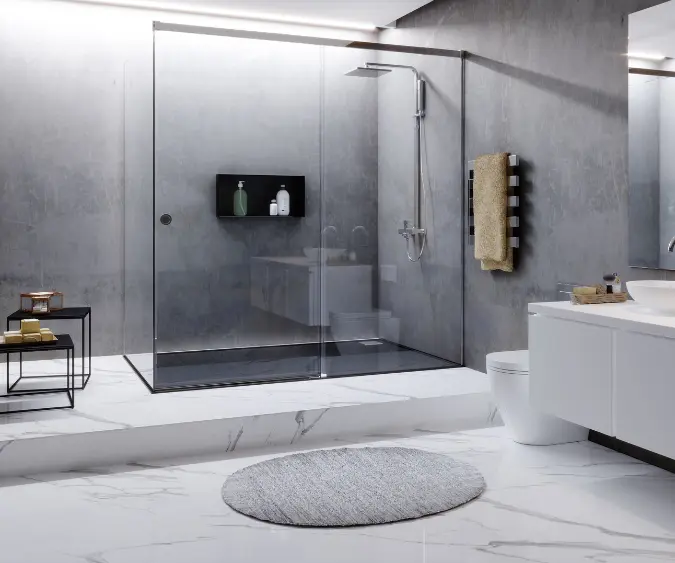
SLIDING
Atenea
Custom-made shower enclosure crafted from stainless steel and tempered safety glass. Customizable configuration, finishes, and glass options.
FINISHES
Polished | Matte | Matte Black | Matte White | Matte Gold | Polished Anthracite | Matte Anthracite | Copper
GLASS
Clear | Frosted | Raywall | TopColor Grey | TopColor Bronze | Fabric Effect | TopKlar | Mirror Effect